Why AIDA and PAS do not work in Reels, and what replaces them
Classic copywriting frameworks were built for readers who chose to read. Short video runs on a different contract.
Why I wrote this
A common pattern in coaching small-business owners on short video: they have read a copywriting book at some point, the book taught them AIDA (Attention, Interest, Desire, Action) or PAS (Problem, Agitate, Solution), and they have been trying to map those frameworks onto their videos. The videos do not work, and they cannot tell whether the problem is the framework or the execution.
It is the framework. AIDA and PAS are genuinely useful for long-form sales copy. They do not survive the contract change between a reader who opened a sales letter and a viewer who is mid-scroll on a phone. The viewer in the feed has not made any of the commitments the framework assumes.
So this is the short version of where the classic frameworks break and what to use instead.
What AIDA and PAS assume
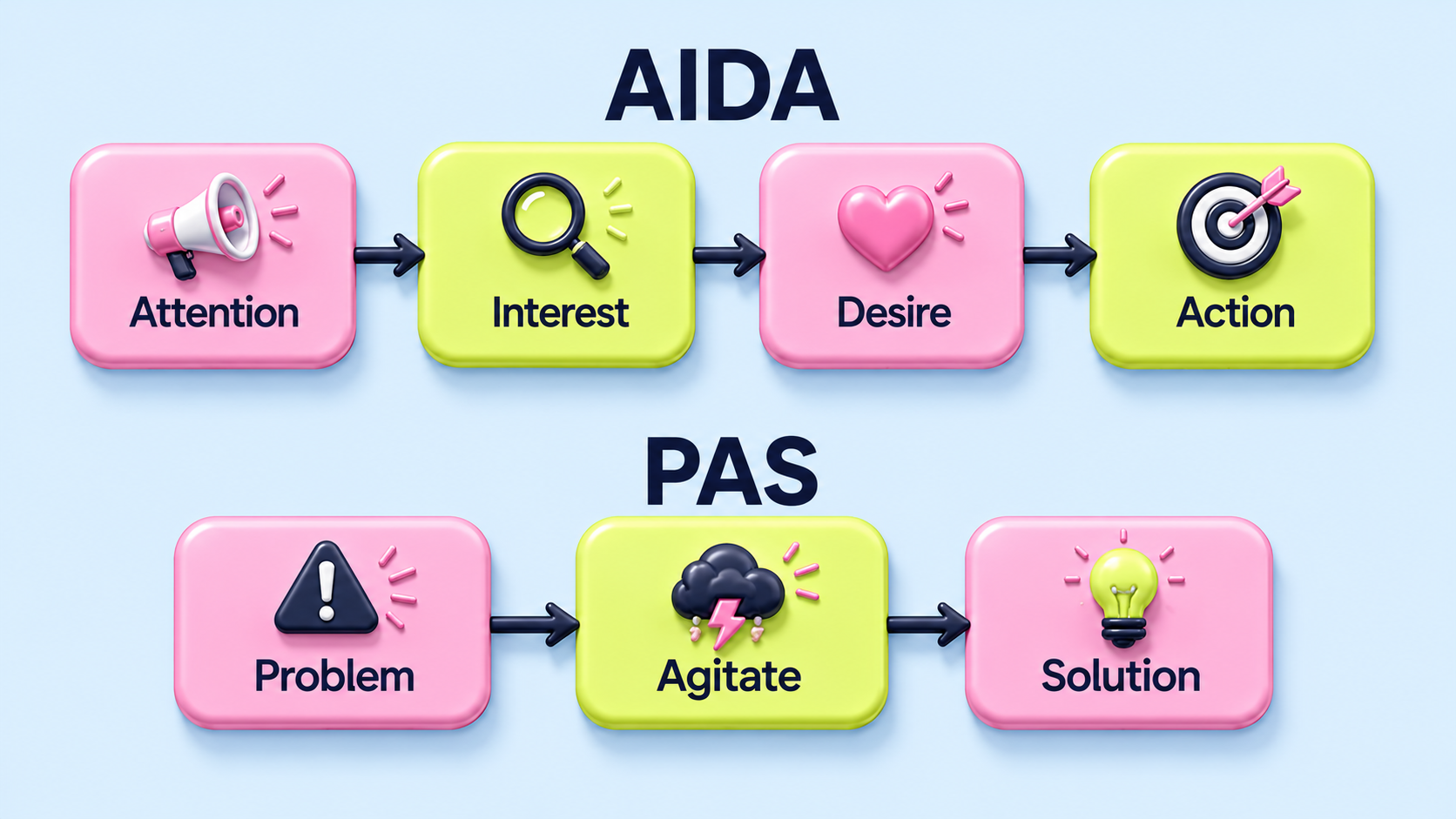
AIDA: Attention, Interest, Desire, Action. The reader is grabbed, then interested, then made to desire the thing, then asked to act. PAS: Problem, Agitate, Solution. The reader is shown a problem, the problem is amplified, the solution is offered.
Both frameworks share three assumptions. The reader has opened the piece (Attention is something you spent to bring them, not something you have to win back every two seconds). The reader expects to read for several minutes (the Interest and Desire phases can take real time). And the reader expects an ask at the end (the Action or Solution is the explicit close).
A viewer scrolling a feed has agreed to none of those. They have not opened the piece in any committed sense. They will not give you three minutes to build Desire. And an explicit close at the end is the thing they swipe away from.
Why each assumption breaks
Attention is rented every second, not bought once
AIDA treats Attention as a single transaction at the top of the funnel. In a feed, attention is rented every second. A video that grabs attention at second one and assumes it can spend the next ten seconds building Interest will lose half its viewers in those ten seconds. The framework allocates effort wrong: too much weight on the second-by-second middle, not enough on the moment-to-moment hold.
Desire takes time the viewer will not give
The Desire phase in AIDA and the Agitate phase in PAS both rely on the reader spending real time absorbing a problem so the solution feels earned. A 15-second video has no room for an Agitate phase. By the time the problem is amplified, the viewer is already on the next video. The frameworks were calibrated for sales letters that ran 800 to 2,000 words. The verticals run 30 to 200.
Explicit closes in video read as ads
A sales letter ends with the Ask, and the reader has agreed to that contract by reading this far. A video ending with "click the link in my bio to learn more" reads as an ad, and modern viewers have learned to flinch from it. The closes that work in video are implicit (a strong final beat that leaves the viewer thinking about the brand) or soft (a name-drop that lets the curious viewer find you). The hard close was a sales-letter convention.
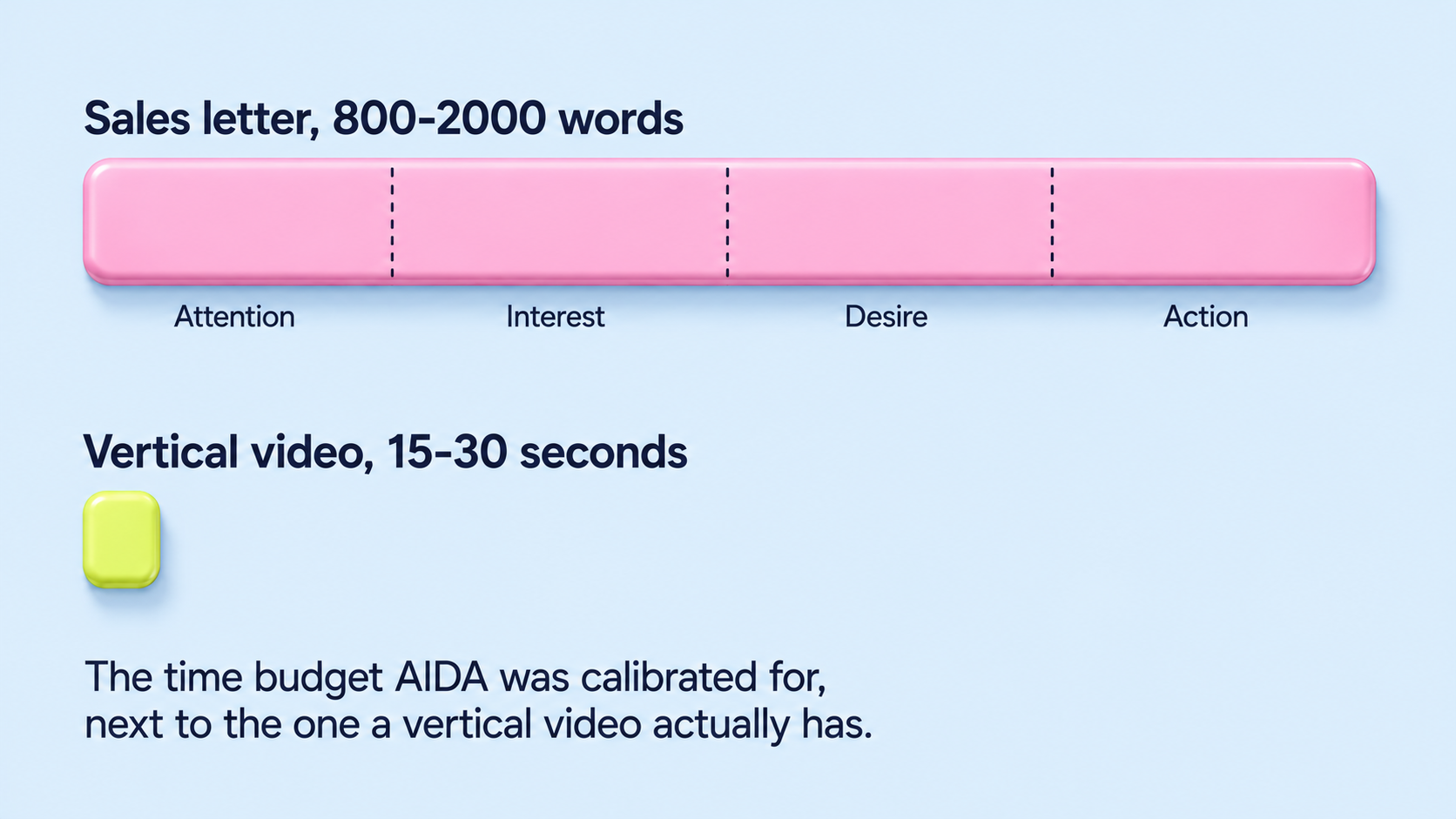
A sales letter assumes a reader who chose to read. A vertical video assumes a viewer who has not decided anything. The contract is different. The framework has to be too.
What replaces them
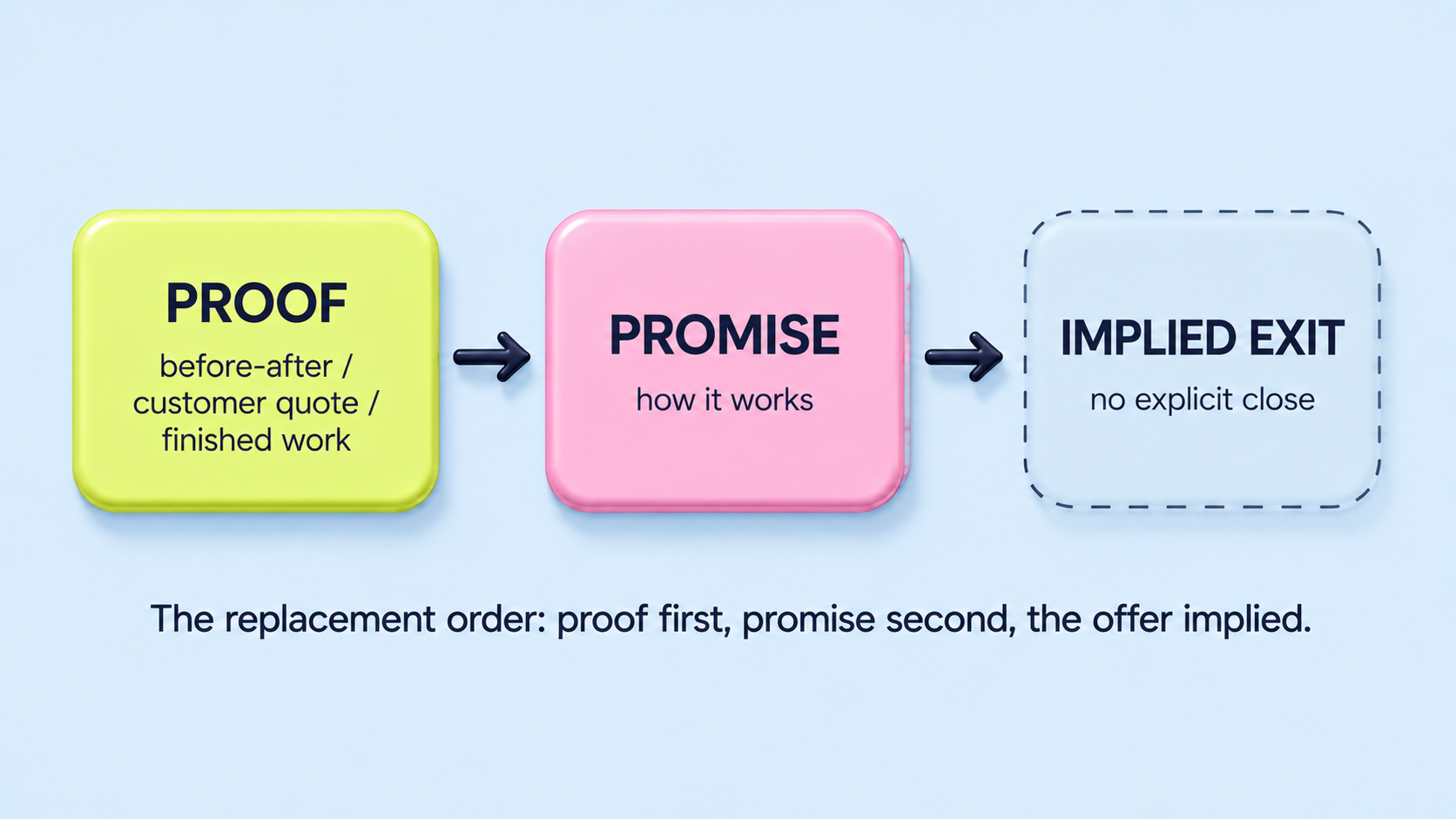
A working pattern for short video flips the AIDA order: proof, then promise, then implied offer. The proof is the first beat (a before-after, a transformation, a piece of work already finished). The promise is the second beat (this is how it works). The offer is implied, not asked for. The viewer who wants the offer goes looking for it; the viewer who does not gets a complete short film with no advert at the end.
For PAS, the analogue is to skip the Agitate phase entirely and let the problem be visible in the proof. The viewer who has the problem recognises it instantly. The viewer who does not is not the audience. Both groups get a clean video; neither gets a sales pitch.
How Jeena lets you A/B the two orders
The fastest way to settle the framework debate on your own footage is to film both versions and run them through a small panel. Each layer in the Jeena report tells you a different thing about which order is doing the work.
- Attention on the first three secondsThe aggregated heatmap shows you which version held the gaze on the speaker (or on the proof) instead of letting it scatter. The AIDA-ordered cut usually leaks attention to the production setup while the script ramps; the proof-first cut anchors the eye on the thing being demonstrated from second one.
- Reactions across the runtimeThe wow-moments chart aggregates blink rate and eyebrow raises across the panel. A proof-first cut usually produces an earlier reaction spike, around the proof reveal. An AIDA cut may produce no spike at all, because Desire-building scripts read as setup rather than payoff.
- How viewers describe each versionThe perception summary distils 5-10 individual impressions surveys into a few descriptors. Watch for the word "ad" or "salesy" on the AIDA version; watch for "real" or "interesting" on the proof-first one. The dashboards do not give you this layer at all; the perception summary is where the framework comparison becomes legible in viewer language.
What this looks like across two reports
Imagine the same 20-second script in two orders. Version A opens with the AIDA Attention-grab (a startled face) then walks through Interest and Desire before getting to the Action line at second 16. Version B opens with the proof (a before-after frame) then drops the promise in one sentence.
A typical Jeena read on the two: Version A perception summary reads "salesy, scripted, hard to relate to"; the heatmap drifts off the speaker around second 5; the wow-moments chart stays flat until the Action line, where it spikes briefly. Version B perception summary reads "useful, clear, real example"; the heatmap holds on the proof; the wow-moments chart spikes at the moment the transformation is visible.
You did not need to publish either video. The two reports gave you the answer in a couple of days.
What this means if you have been writing scripts in AIDA
Rewrite the order. Open with the proof, not the attention-grab. The proof is the attention-grab. Then the promise (how the thing works), as briefly as the proof allows. Then stop. The implied offer is the rest of your account: if the proof was real and the promise was clear, the curious viewer can find what to do next.
For PAS scripts, fold the Agitate beat into the Problem visual. A viewer who has the problem does not need it amplified. They have been living it. The Agitate phase in long-form copy was a way to get a reader who is not in pain to imagine being in pain, which short video has neither the time nor the licence for.
The classic frameworks are not wrong. They are calibrated for a contract that no longer applies in this medium. If your long-form work still uses them and works, keep doing it. For short video, the order is proof, promise, exit.
See whether the rewritten order actually works on real viewers
Film both versions of your video, the AIDA-ordered one and the proof-promise-exit one, and upload them to Jeena. Real viewers watch them on their phones with the front camera on. The attention heatmap shows you whether the proof-first opener held the gaze, the wow-moments chart flags whether viewers reacted earlier, and the perception summary tells you how viewers described each version. The two reports show you which framework actually fits the medium.
No "schedule a call." No sales rep. Upload, get your reports in a couple of days, decide which order is doing the work.
Frequently asked
Are AIDA and PAS completely useless for short video?+
No. They are calibrated for a different contract (a reader who has already chosen to read), and forcing them into a 15-to-30-second vertical video produces scripts that allocate effort wrong. The underlying instincts (grab attention, hold interest, make the offer easy) still apply. The specific four-step or three-step structure does not survive the time budget of the medium.
What replaces AIDA in short video?+
A working pattern is proof, promise, implied exit. The proof is the first beat (a before-after, a finished piece of work, a real customer quote). The promise is the second beat (how the thing works). The exit is implied, not asked for. The hard close at the end of a sales letter reads as an advert in video and gets swiped from.
Why does the PAS Agitate phase fail in vertical video?+
The Agitate phase in long-form copy was a way to make a reader who is not currently in pain imagine being in pain, so the solution would feel earned. Short video has neither the time budget (30 seconds will not let you build that imagined pain credibly) nor the contract (a feed viewer has not agreed to be made uncomfortable). The fix is to let the problem be visible in the proof. The viewer who has the problem recognises it instantly. The one who does not is not the audience.
What is Jeena?+
Jeena is a neuromarketing platform for short-form video. Real people watch your video on their phone with the front camera on. Jeena captures their gaze direction, blink rate, eyebrow raises, and their impressions of the video in a short survey afterward. You receive an AI-powered report with an attention heatmap, a visibility map, a wow-moments chart, a summary of how viewers perceived the video, and three specific recommendations for making the video work harder.
How does Jeena measure viewer attention?+
Jeena uses smartphone front-camera gaze tracking. Each engager calibrates once, then watches your video. The platform records where their gaze lands frame by frame, flags moments of surprise from facial expression, and combines that with a short impressions survey afterward. The result is a per-second timeline of what real viewers actually looked at and felt, plus a summary of how they perceived the video overall.
How much does it cost to test a video on Jeena?+
A typical test costs around ten euros. See the pricing page for current rates.