Fun, Contact, or Use: the three reasons people watch short video
The payoff filter every video has to pass, and how to pick which one a piece targets before you film.
Why I wrote this
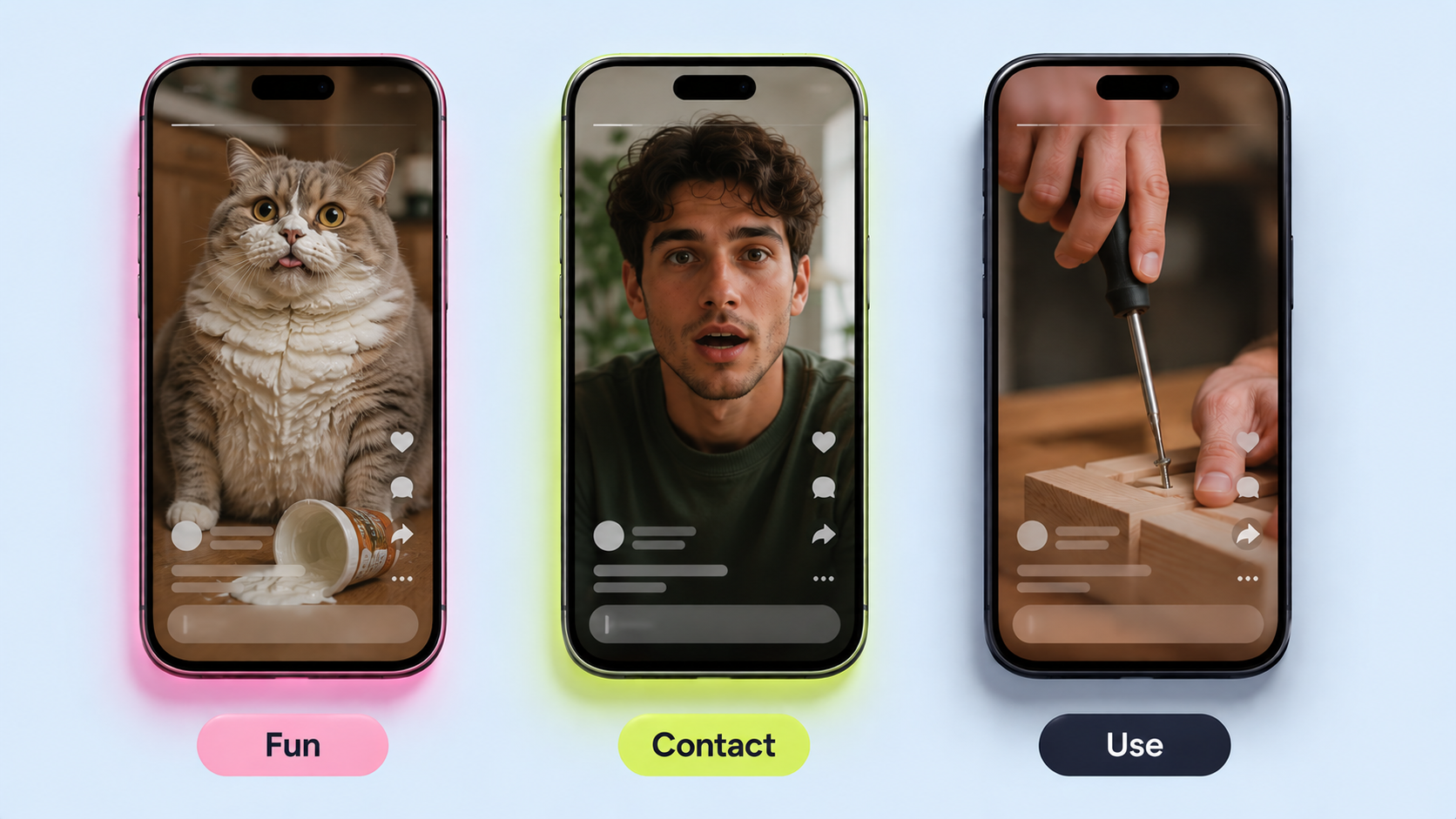
Most short-video advice tells you to be useful, be relatable, and be entertaining all at once. That is not advice. That is a wish list. In practice, the videos that work pick one of those three to deliver, and let the other two sit in the background as flavour.
Surely a great video does all three at once, I thought. Some do. They are also rare, and trying to plan for them is the most reliable way to make a video that does none. The much higher-percentage move is to pick the one your video is for, before you start filming, and use it as the filter for every other decision.
So this is the simplest version of how I think about it. Three reasons people watch. Pick one. Hold it through the whole video.
What each payoff is
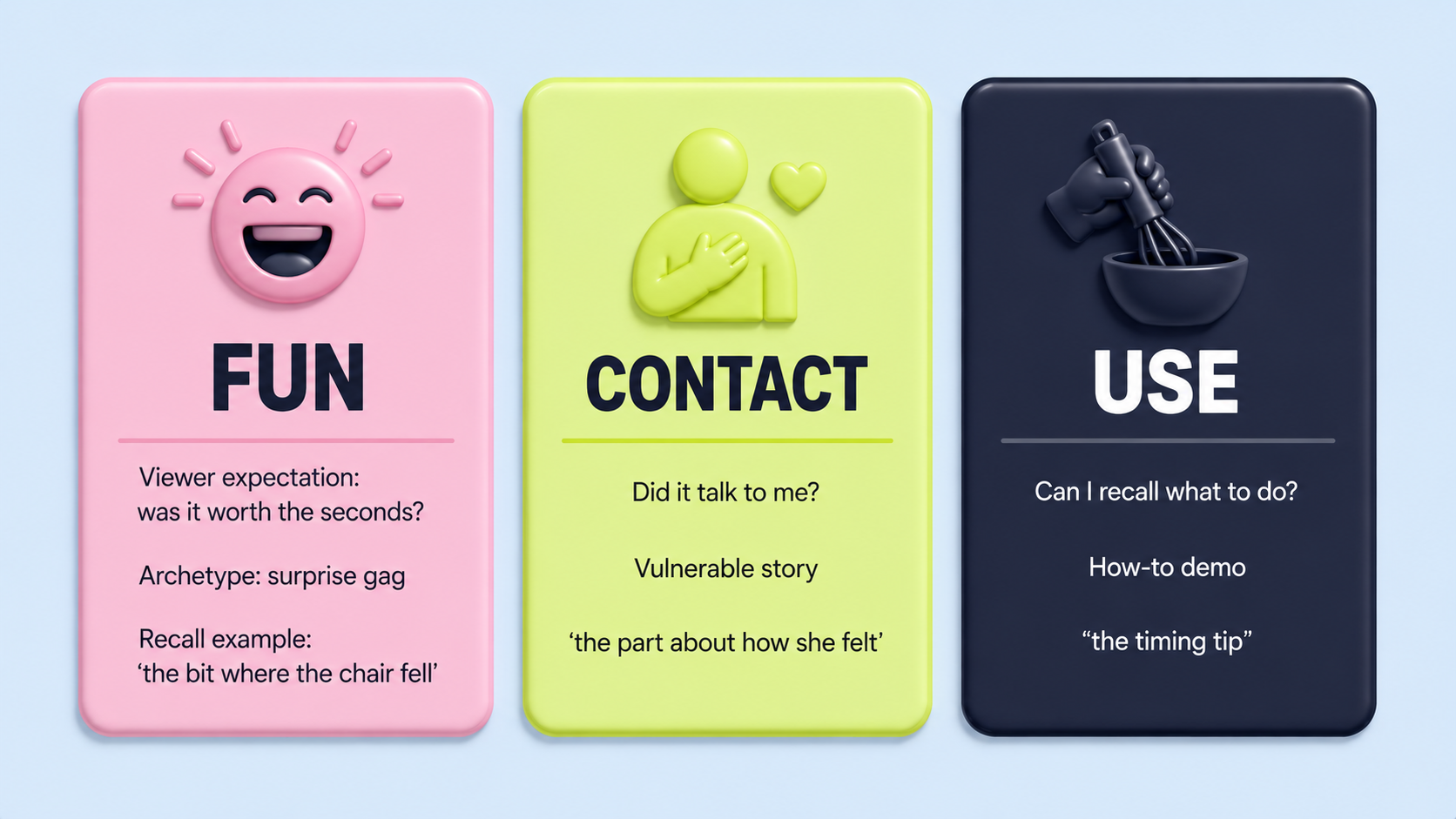
Fun is entertainment. The viewer leaves with a laugh, a surprise, an aesthetic pleasure, or a vicarious thrill. The metric the viewer is checking against (mostly unconsciously) is whether the video was worth the seconds it took.
Contact is recognition and connection. The viewer leaves feeling seen, recognised, like the creator just put words to something they have been thinking. The metric is whether the video felt like it was talking to them.
Use is utility. The viewer leaves with a practical takeaway they can apply tomorrow. The metric is whether they can recall what to do next.
How to pick which one your video is for
Start from what you actually have
If your video has a clear takeaway you can summarise in one line, it is a Use video and you should write the rest of it around that line. If it has a story about something that happened to you that other people in your situation would recognise, it is a Contact video. If neither of those is true but the idea is genuinely funny or genuinely surprising, it is a Fun video. Forcing a Use video to be funny, or a Fun video to have a takeaway, dilutes both.
Match the format to the payoff
Fun videos lean on cuts, audio, and surprise. They are short and the hook is the funniest beat upfront. Contact videos lean on a face, a real story, and a slower pace that lets the viewer settle in. Use videos lean on a clear structure (here is the move, here is how, here is why) and on-screen text the viewer can pause and screenshot. Filming a Contact video at the cut pace of a Fun video makes it feel insincere.
Decide before you press record
The single biggest mistake in small-business short video is hedging. Filming something that is "kind of useful, kind of funny" almost always lands as neither. The decision about which payoff this piece is delivering should be made before the camera comes out, written on paper, and not relitigated during editing. If you find yourself in the edit trying to make the video also be useful, the video is a Fun video. Stop editing and ship it as one.
A video that targets Fun, Contact, and Use at once usually lands on none. Pick one before you press record, and let the other two be flavour.
The perception summary exposes the payoff
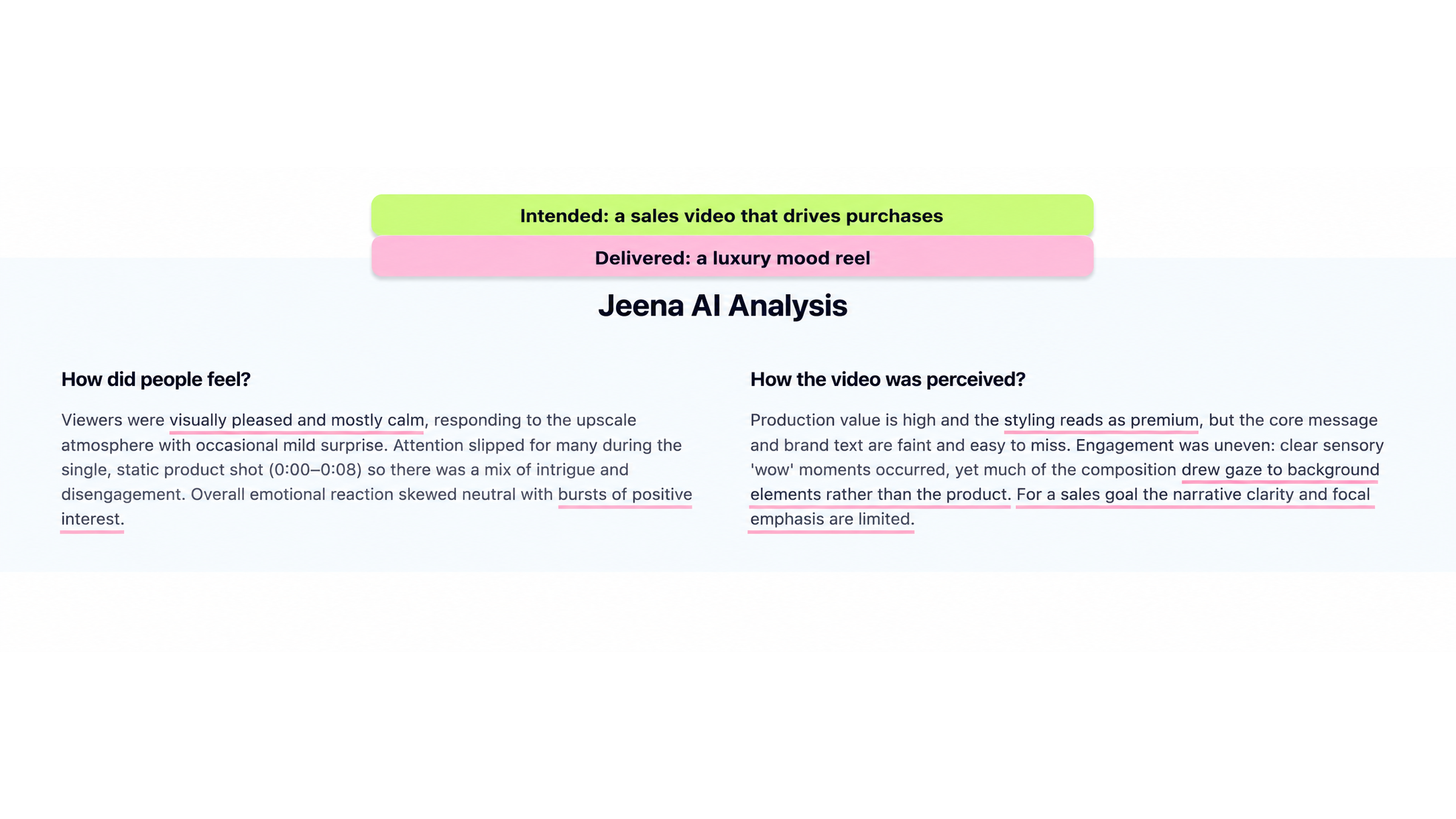
When viewers watch a video on Jeena, the post-watch impressions survey distils into a perception line in the report. That line reveals which payoff actually landed, regardless of which one the creator intended. A Fun video gets perceived as funny and surprising. A Contact video gets perceived as relatable and honest. A Use video gets perceived as informative and practical.
A video that gets a mix of descriptors across all three payoffs is usually a video where the creator never decided which one it was for, and the perception line shows it. Different viewers picked up different qualities, because the video did not commit to one.
How Jeena tells you which payoff actually landed
The point of a payoff filter is to decide before you film. The point of testing afterward is to find out whether the payoff you targeted is the one viewers received. Those are two different questions, and the second one is what a Jeena report answers.
Three layers of data line up against the three payoffs. Gaze tells you whether the video held attention at all. Reactions tell you whether the beats you intended as Fun, Contact, or Use actually triggered something. Perception tells you which descriptor cluster the viewer reached for when they had to put the video into words.
The three layers a payoff has to clear
- Attention through the beatThe aggregated heatmap shows whether viewers held attention through the moment that was supposed to deliver the payoff. A Fun beat that nobody is looking at when the joke lands is a beat that delivered nothing.
- Reaction at the right secondA wow-moment is a flash of surprise picked up as an eyebrow raise. For a Fun video the reaction is meant to spike at the punchline. For a Contact video, at the recognised line. For a Use video, at the new piece of information. A flat reaction line through the payoff beat is a payoff that did not land.
- Perception in the words viewers useThe post-watch survey distils into a perception line. Funny and surprising means the Fun landed. Relatable and honest means the Contact landed. Informative and practical means the Use landed. A perception line that smears across all three is a video that hedged.
What this looks like in the report
A working Use video shows a tight cluster: attention held through the takeaway beat, a small reaction spike when the move is named, and the perception line containing "informative" and "practical." A working Fun video shows a different shape: high attention from the first second, a sharp reaction spike at the punchline, and the perception line saying "funny" or "surprising."
When the report shows mismatched layers (held attention but no reaction, or strong reaction but a perception line on the wrong descriptors), the video was trying to deliver one payoff and accidentally delivered another. A recut rarely fixes this. The next video does, planned around the payoff this one accidentally delivered.
What this means if you are planning the week
You do not need every video to be a Use video. A feed that is all Use becomes a how-to channel, which works for some niches and feels dry for most small businesses. A feed that is all Fun is hard to convert into customers. A feed that is all Contact builds parasocial closeness but does not move people to act.
A reasonable weekly mix for a small business is one Use video, one Contact video, and one Fun or Use depending on the week. The point is not the ratio. The point is that each individual video is one of the three, not a smear across all three.
When you cannot decide which payoff a video is targeting, that is the answer. The video is not ready. Decide before filming, not in the edit.
See which payoff your video actually delivered
Upload your video to Jeena. Real viewers watch it on their phones with the front camera on, then share their impressions in a short survey. The perception summary in the report tells you which payoff actually landed (the joke, the connection, or the takeaway), which is rarely the same as the one the creator intended. The attention heatmap and wow-moments chart show you where viewers reacted, so you know which beats were doing the payoff work.
No "schedule a call." No sales rep. Upload, get your report in a couple of days, see which payoff your video is really for.
Frequently asked
Can a single short video deliver all three of Fun, Contact, and Use?+
Rarely. The videos that hit all three are usually accidents, and trying to plan for them is the most reliable way to deliver none. The much higher-percentage approach is to pick one payoff per video, build the whole piece around delivering it cleanly, and let any of the other two that happen to land be a bonus.
Which payoff converts best for a small business?+
Use videos tend to convert best into "I will try that service" actions, because the viewer has already applied something from the creator and trusts the rest of the catalogue. Contact videos build the longest-running relationships and the loyalest customer cohorts, but conversion is slower. Fun videos convert well into reach and reposts, less well into direct purchase. Most small businesses should bias toward Use for conversion and Contact for retention, with Fun as the reach lever.
How do I know which payoff my video actually delivered?+
Ask three viewers how they would describe the video in a few words. Their descriptors will cluster on one of the three payoffs (funny, surprising for Fun; relatable, honest for Contact; informative, practical for Use), and that is the payoff the video delivered, regardless of the creator intention. If the three viewers cluster on three different payoffs, the video did not commit to one, which is a stronger signal than getting low retention numbers.
What is Jeena?+
Jeena is a neuromarketing platform for short-form video. Real people watch your video on their phone with the front camera on. Jeena captures their gaze direction, blink rate, eyebrow raises, and their impressions of the video in a short survey afterward. You receive an AI-powered report with an attention heatmap, a visibility map, a wow-moments chart, a summary of how viewers perceived the video, and three specific recommendations for making the video work harder.
How does Jeena measure viewer attention?+
Jeena uses smartphone front-camera gaze tracking. Each engager calibrates once, then watches your video. The platform records where their gaze lands frame by frame, flags moments of surprise from facial expression, and combines that with a short impressions survey afterward. The result is a per-second timeline of what real viewers actually looked at and felt, plus a summary of how they perceived the video overall.
How much does it cost to test a video on Jeena?+
A typical test costs around ten euros. See the pricing page for current rates.