What to actually film for Reels: a small-business inventory
Not "make engaging content." A concrete list of formats, the hook each one carries, and where each one breaks.

Why I wrote this
Every small-business owner I talk to about short video gets stuck on the same first step. Not how to film, not what to use, not which app. What to actually film. The advice they have heard for years sounds like "post more, be authentic, show personality." It is not advice. It is a vibe.
Surely there is a short, useful list somewhere, I thought. Seven or eight formats that actually work for a small business, written in a way a florist or a personal trainer can pick from on Sunday night and shoot on Monday morning. I went looking. The best of what I found was either format theory written for ad agencies or trend bait that goes out of date in six weeks.
So here is the list I wish someone had handed me two years ago. Each format is paired with the hook pattern it tends to carry and the trap it tends to fall into. Pick one. Shoot it. The point is not to use them all.
How to read this list
Each format below has three things attached: what it is, what kind of payoff it gives the viewer, and the way it usually breaks. The break is the part most listings skip. Knowing how a format fails is the whole reason you would pick a different one.
A useful filter before you read: ask which one your audience would actually scroll past. Not which one sounds smart in a strategy doc. The format that fits is the one your audience will not skip in the first two seconds, not the one with the cleanest theory.
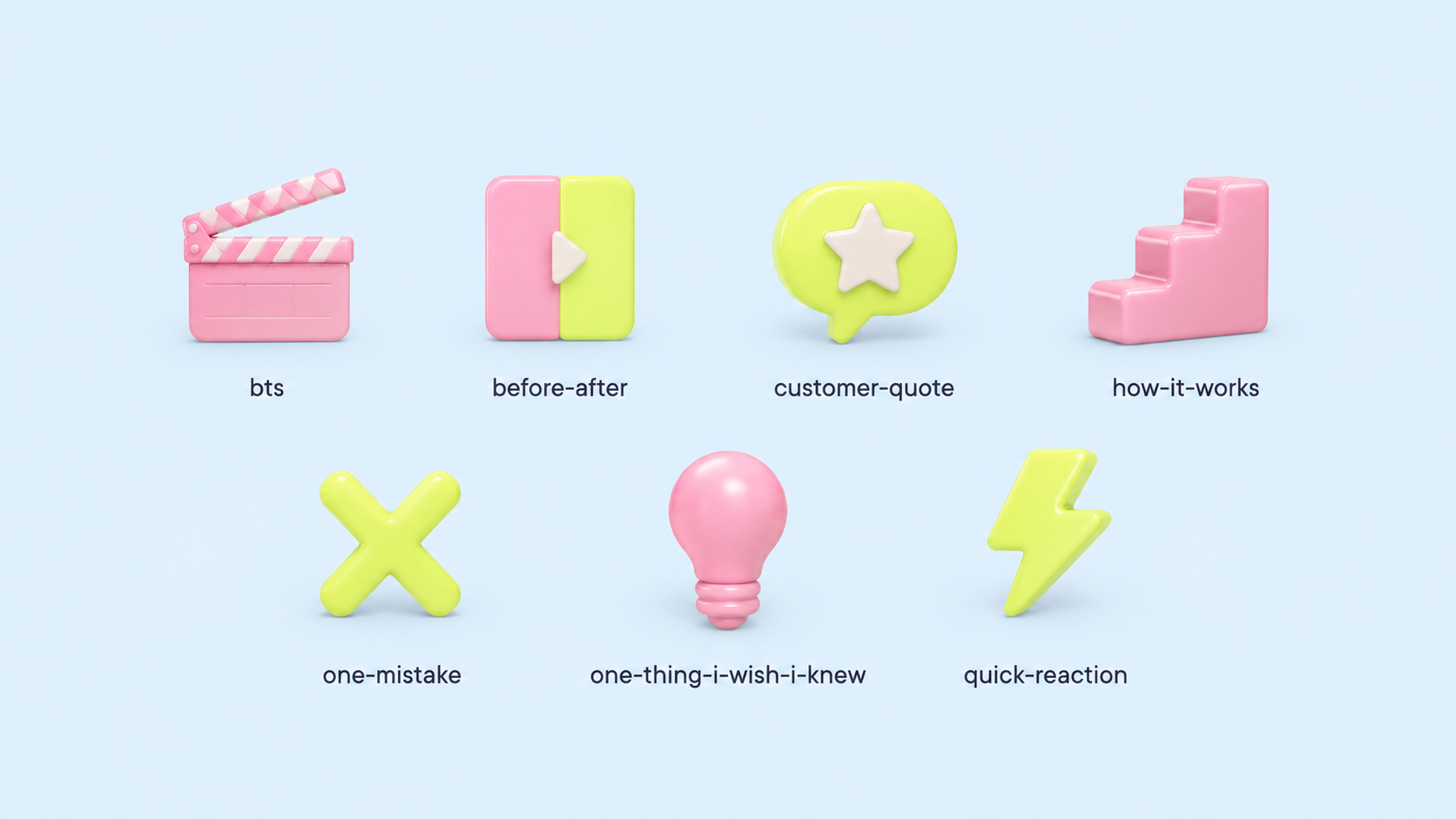
Seven formats that actually work for a small business
Behind-the-scenes (BTS)
A short look at how the thing is made. The hook: a glimpse of process the viewer cannot see anywhere else (the kitchen at 6am, the studio mid-shoot, the order pile on a Friday). Payoff: contact, the viewer feels they know you. Break: too sanitised. If the BTS looks like a brand reel, it is not BTS. Keep the lighting honest.
Before-after
Two clean states of the same thing with the change cut to one beat. The hook: the after, glimpsed in the first half second. Payoff: use, the viewer learns the move. Break: pacing. If the transition takes more than one second, the viewer is gone before the after lands.
Customer quote
One short sentence from a real customer, voiced over a clip of the product or service in use. The hook: the quote on screen, full sentence visible by second one. Payoff: contact, social proof at human scale. Break: scripted-sounding language. If it reads like a testimonial page, viewers feel the marketing and leave.
How-it-works
Two to four steps of how the service or product actually works, shown not explained. The hook: a frame that promises the end state. Payoff: use, the viewer can repeat the move or knows what to expect. Break: trying to cover too many steps. Four is a hard ceiling for a sub-30-second video.
One mistake clients make
A specific wrong move you see repeatedly, with the right move shown next. The hook: name the mistake by sentence two. Payoff: use, the viewer corrects something. Break: vague mistake. "Be more consistent" is not a mistake. "Watering succulents weekly" is.
The one thing I wish I knew
A short personal aside about an insight you wish you had earlier in your work. The hook: the framing itself ("the one thing I wish someone had told me about X"). Payoff: contact, the viewer feels you are a few steps ahead. Break: insight is generic. "Start sooner" is not the insight. The specific reason you wish you had started sooner is.
Quick reaction to a thing in your space
You see a piece of content or news in your niche and give a 20-second take. The hook: the thing you are reacting to, on screen, before your face. Payoff: contact, sometimes fun. Break: lukewarm take. If you do not actually have an opinion, the video has nothing.

If your camera roll is empty, you have not run out of ideas. You have run out of format.
Pick one format per shoot day
The most common small-business mistake is trying to film a BTS, a customer quote, and a how-it-works on the same afternoon, ending up with three half-finished videos and no posted one. Pick one format per shoot day. Film three takes of the same shape. Post the best one.
A single format also makes the post-shoot edit fast. You are not deciding which video to make. You are just picking the best take of the one you already chose.
How Jeena tells you whether the format worked
A format works when the hook beat catches and the payoff lands. Most format failures are one of those two, and from the inside it is hard to tell which one broke. The Jeena report separates them.
Read three layers against the format you chose. The first tells you whether the opening beat held. The second tells you whether the format mechanic delivered. The third tells you whether the payoff matched the format.
The three layers a format has to clear
- Attention on the format hookThe aggregated heatmap shows where viewers looked during the defining beat. The after-frame of a before-after, the quote on screen for a customer quote, the first BTS reveal. If attention is flat or scattered on that frame, the format hook is the variable to change before you re-shoot.
- The format mechanic itselfEach format has a mechanic that has to fire correctly. A before-after needs the transition to read in one beat. A customer quote needs the full sentence visible by second one. A how-it-works needs the steps to be countable. The wow-moments chart shows whether viewers register the mechanic where it should fire.
- Perception matches the format payoffThe perception line tells you which payoff landed. BTS and customer-quote videos that get described as "informative" delivered Use instead of Contact, which means the format ran but the payoff missed. Before-after videos described as "relatable" did the same in reverse. The format and the payoff have to line up.
What this lets you decide before week two
After one week of five videos in the same format, you have five reports of the same shape. That is a readable signal. If the hook layer fails consistently, the format opening needs a redesign (not the format). If the mechanic layer fails, the editing pattern needs to change. If the perception layer keeps missing the intended payoff, the format itself is wrong for what you want to convey, and the next week tries a different one.
The point is that the three failure modes have three different fixes, and reading the report by layer tells you which one you are in.
What this means if you are starting from zero
Start with the format that fits the thing about your business you most want a stranger to understand in 15 seconds. If that thing is your process, BTS. If that thing is the change you create, before-after. If that thing is what your customers feel, customer quote.
Run the same format for a week before you switch. Five videos of the same shape teach you more about what works for your audience than five videos of five different shapes. The format is the variable you are testing. Hold the other variables steady so the data is readable.
Then test the hook. The format is the container. The hook is what gets the container opened. If five customer-quote videos all underperform, the format is fine. The hook is the variable to change.
Test the format before you commit a month of shooting to it
Pick one format, film one take, and upload it to Jeena. Real viewers watch it on their phones with the front camera on, and share their impressions in a short survey. Jeena maps where their eyes went, when they raised their eyebrows, and which moments lost them. You get an attention heatmap, a visibility map, a wow-moments chart, a summary of how viewers perceived the video, and three concrete recommendations.
No "schedule a call." No sales rep. Upload, get your report in a couple of days, decide whether the format is worth shooting again.
Frequently asked
How long should a short-form video be for a small business?+
Between 12 and 30 seconds for most of the formats above. Customer-quote and one-mistake formats land under 15 seconds. How-it-works and BTS often want 25 to 30. Going past 35 seconds means you are usually padding rather than tightening.
Do I need to post every day to grow a small-business account?+
No. Three videos a week of one consistent format works better than seven mixed-quality videos of seven different formats. Algorithms reward retention and re-watches per video, not raw post volume. A small-business account with one strong format posted three times a week tends to outperform a daily account that has not picked a format.
Which format works best for service businesses (vs product)?+
Service businesses tend to win on the one-mistake and the customer-quote formats, because the value of a service is invisible until someone tells you what they got out of it. Product businesses tend to win on before-after and how-it-works, because the product itself does the visual storytelling. Both kinds can use BTS, but the BTS payoff is contact, not use, so it is a relationship-building format rather than a conversion-driving one.
What is Jeena?+
Jeena is a neuromarketing platform for short-form video. Real people watch your video on their phone with the front camera on. Jeena captures their gaze direction, blink rate, eyebrow raises, and their impressions of the video in a short survey afterward. You receive an AI-powered report with an attention heatmap, a visibility map, a wow-moments chart, a summary of how viewers perceived the video, and three specific recommendations for making the video work harder.
How does Jeena measure viewer attention?+
Jeena uses smartphone front-camera gaze tracking. Each engager calibrates once, then watches your video. The platform records where their gaze lands frame by frame, flags moments of surprise from facial expression, and combines that with a short impressions survey afterward. The result is a per-second timeline of what real viewers actually looked at and felt, plus a summary of how they perceived the video overall.
How much does it cost to test a video on Jeena?+
A typical test costs around ten euros. See the pricing page for current rates.