What focus groups got right that analytics dashboards forgot
Talking to viewers is unfashionable. It is also where the why lives.
Why I wrote this
For most of the last decade, talking about focus groups in a tech company has been a way to get politely ignored in a meeting. The dashboard era taught everyone that real signal lives in large-n behaviour data, and that asking people what they think is a waste of time because they will say one thing and do another.
A lot of that critique is correct. Focus groups had genuine problems: dominant voices, polite agreement, the moderator nudging the room, the gap between what people say and what they do. But the dashboard era also threw out the part of qualitative research that nothing has replaced: the moment a viewer describes what they just saw in their own words, and the language they use surprises you.
So this is the short version of what focus groups got right, where they actually broke, and what the modern lighter equivalent looks like. The form is different (a few perception descriptors instead of a verbatim transcript), but the qualitative read it produces lives in the same intellectual neighbourhood.
What the dashboards leave out
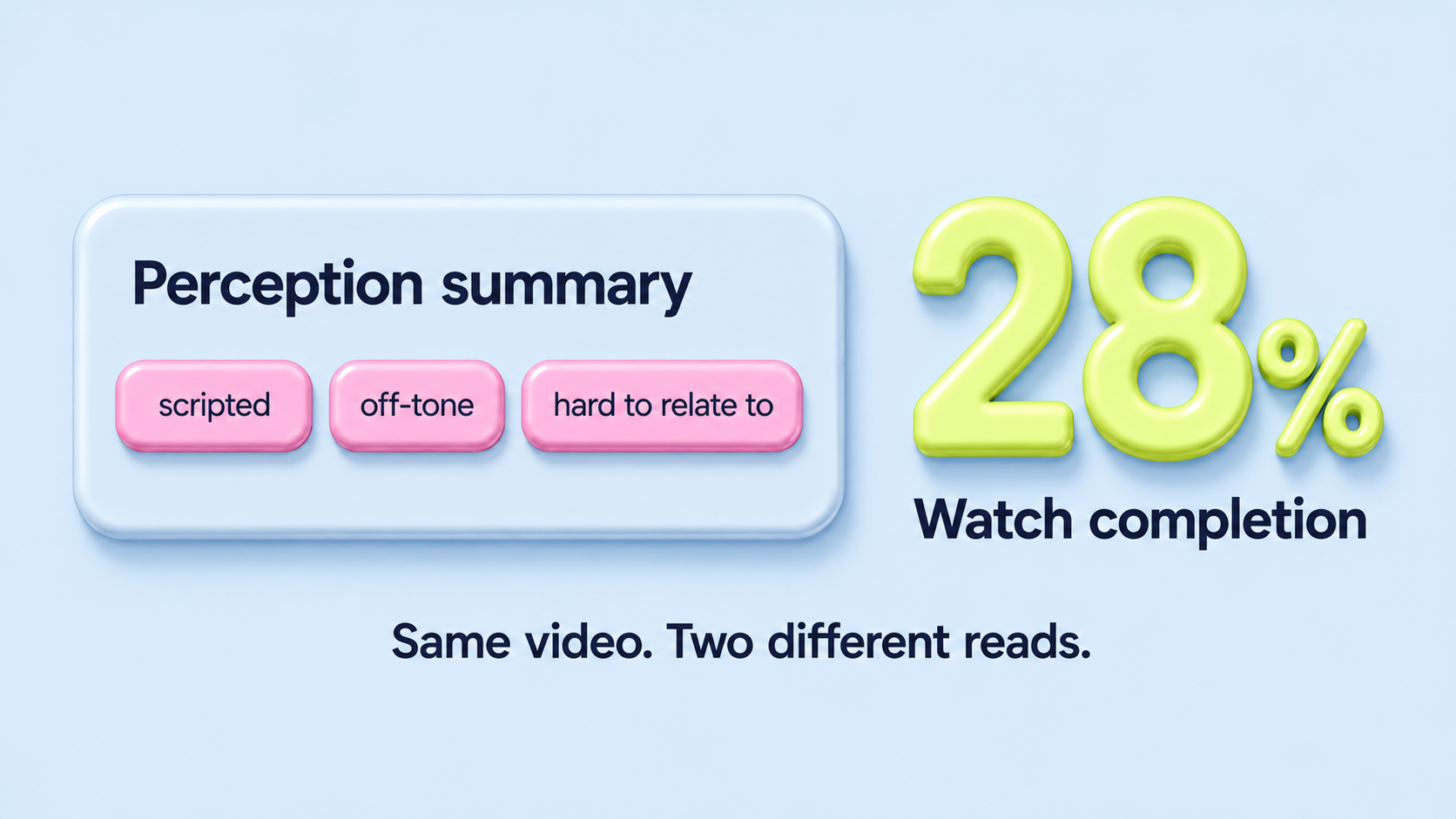
An analytics dashboard tells you what the video did. Watch completion, retention curve, likes, shares, follows. That is genuinely useful, and it has all but replaced what teams used to ask focus groups for. But it cannot tell you what viewers thought the video was about. It cannot tell you which descriptor they would reach for to describe the brand afterwards. It cannot tell you whether the joke was funny in the way you intended or funny in a way you did not see coming.
For products, those gaps matter less. For content, they are most of what you need to know. Two videos with the same watch-completion can leave the audience with completely different impressions of who you are. The dashboard reports them identically.
Three things focus groups got right
They captured the language
The most useful output of a focus group was never the average rating. It was the sentence one participant said, off the cuff, that perfectly described how the brand came across. That sentence then became headline copy or a script revision, because it was already the audience saying it back. Dashboards have no equivalent of this; they give you numbers, not language. The modern lighter version (a perception survey distilled into a few descriptor lines) sits in the same intellectual category. It is a digested form rather than the verbatim sentence, but the descriptors viewers reach for are still the audience saying it back.
They surfaced confusion early
When a focus group did not understand a piece of work, it showed up immediately in the room. The wrong word landed, the wrong reference was caught, the wrong tone made the room go quiet. Dashboards detect confusion much later, often only by inference from low engagement, and never with the granularity to know which beat caused it.
They made strangers feel like people
Looking at a watch-through percentage or a retention curve is abstract. Watching a real person react to your work changes how you think about your audience. The team that has watched ten real viewers react has a fundamentally different mental model of "the audience" than the team that has only looked at dashboards. That mental model affects every future decision, often more than any single metric does.
The most useful output of a focus group was never the average rating. It was the sentence one participant said that you ended up using in the headline.
The modern version fixes the bias problems
The classic focus-group problems (group think, dominant voices, the moderator nudging, social desirability bias) all share the same root cause: viewers were in a room together. Take them out of the room, and most of the problems disappear. Five viewers each watching your video privately, on their own phone, then sharing their impressions in a short survey, gets you the qualitative read without the group dynamics.
You lose the group conversation itself, which is occasionally where the best insights came from. You gain honest individual reactions and a perception summary that captures the audience descriptors. The trade is worth it for most content decisions.
How Jeena gets the focus-group read without the focus group
The classic focus-group problems all share one root cause: viewers were in a room together. Three measurement choices remove that root cause while keeping the qualitative output.
- Solo watching, never groupedUp to 10 viewers (minimum 5) each watch the video privately on their own phone. They never see each other and never discuss the video. Group-think, dominant voices, polite agreement: none of those distortions can form because there is no group.
- Short individual impressions surveyAfter each watch, the viewer rates the video on a five-point scale and picks from a fixed set of emotion tags ("interesting", "funny", "boring", and so on). The items are the same for every viewer, so there is no moderator nudging the answer. The perception summary in the report is distilled from these individual responses alongside the gaze and facial-expression track.
- Gaze plus facial expression underneathSelf-report distorts; the front-camera gaze track and mimics layer do not. The aggregated heatmap and the wow-moments chart show you what viewers actually looked at and reacted to, second by second, alongside what they said. The two layers cross-check each other.
What this looks like on a real report
Imagine a brand-awareness video. Instagram tells you "47 percent watch-through, 1.2 percent like rate." Useful, but you cannot act on it directly.
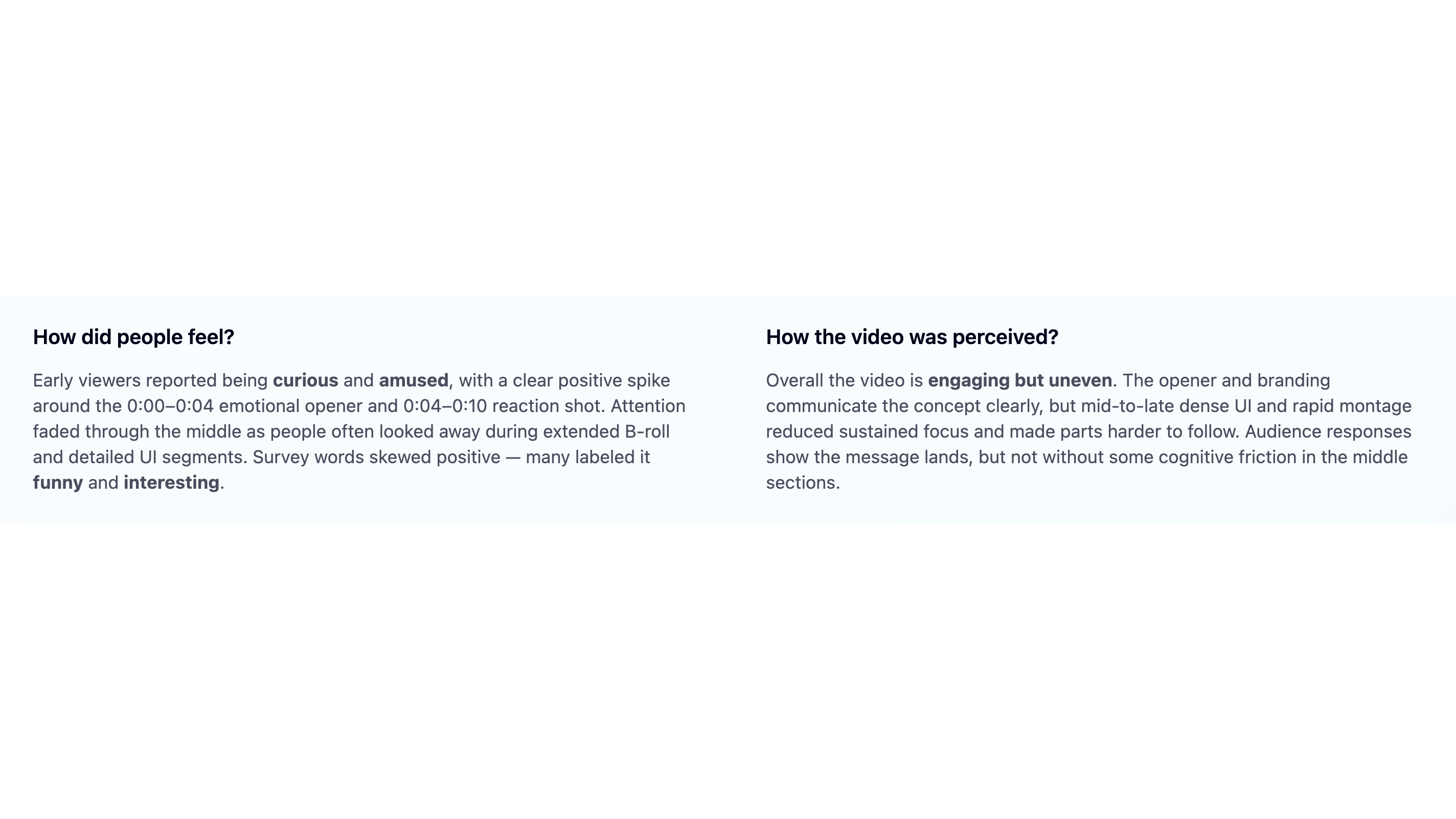
The Jeena AI analysis for the same panel of 10 viewers might describe the video as positive but fragile: viewers rated it well and called it interesting, but attention dropped repeatedly through the middle and the wow-moments never strung together into a sustained reaction. That descriptive paragraph is the AI's synthesis of two layers: what the panel did (gaze track, facial-expression spikes, blink rate, emotion-tag picks, star ratings, and on private audits the open comments) and what the video itself contained (the scene-by-scene description, the speech transcript, the on-screen text timeline). The fix list writes itself: tighten the middle, plant a recovery beat around the attention drop, rework the moments that should have triggered wow.
What this means if you have been relying on dashboards
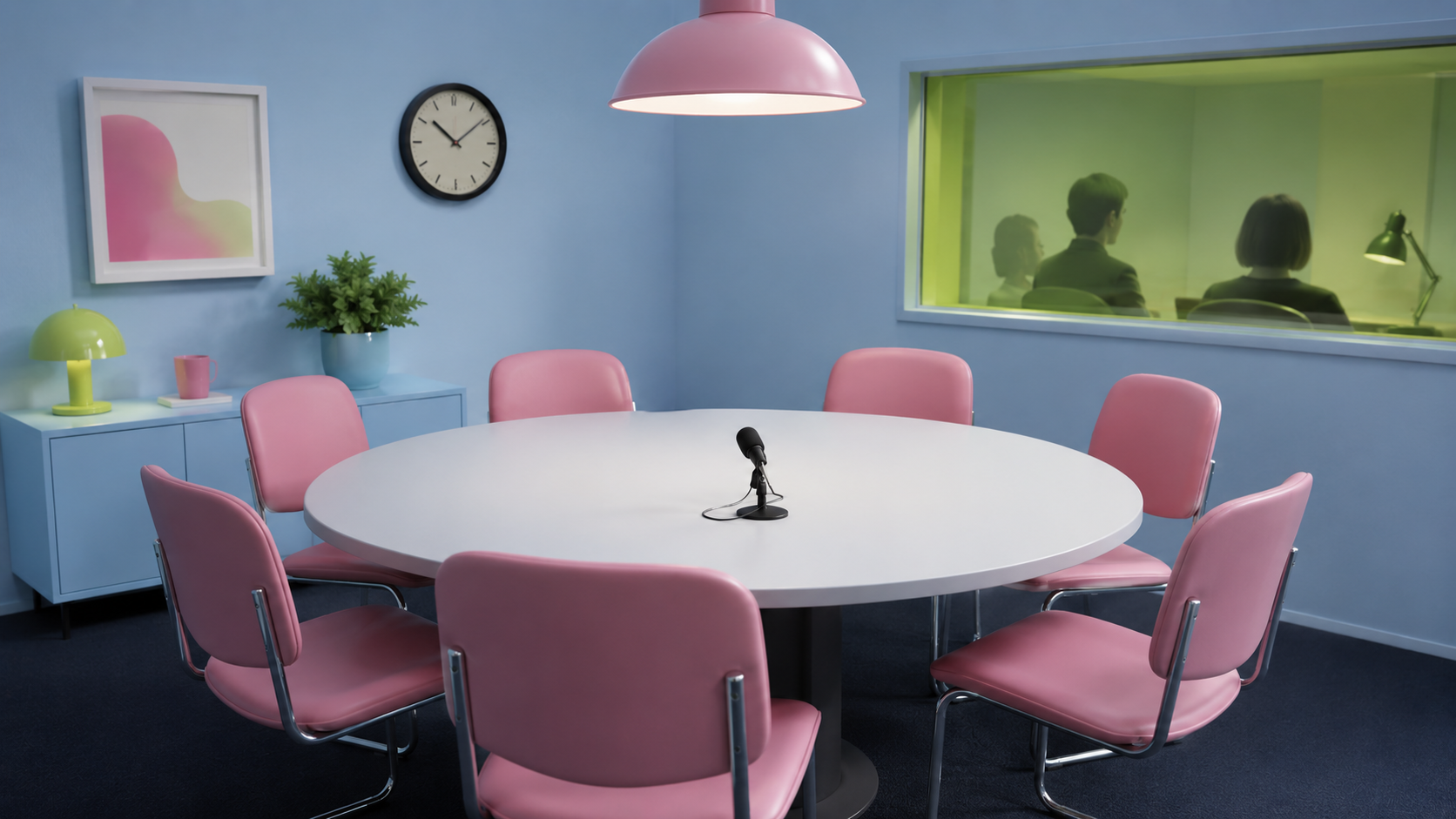
You do not need to bring back the round table with the one-way mirror. You do need a way to read how real viewers experienced the video, before the dashboard tells you whether it worked.
For short video, the modern version of this is a small panel of real viewers watching privately on their phones, with a short impressions survey at the end. The Jeena report distils those impressions into a perception line that captures how the video came across in the viewers' own descriptors. Same intellectual category as a focus-group transcript, in a digested form that takes a couple of days instead of weeks.
The data this produces does not replace the dashboard. It pairs with it. The dashboard tells you what the video did. The perception summary tells you how it came across. Both matter, and the second is the part most teams have stopped collecting.
Get the qualitative read on your video, without the focus-group baggage
Upload your video to Jeena. A small panel of real viewers watches it on their phones with the front camera on, privately, then shares their impressions in a short survey. You get the perception summary distilled from those impressions, alongside the attention heatmap, the visibility map, the wow-moments chart, and three recommendations.
No "schedule a call." No sales rep. Upload, get your report in a couple of days, read what your viewers actually thought.
Frequently asked
Why did focus groups fall out of favour in the analytics era?+
A few reasons, mostly fair. They were slow and expensive. The group dynamics distorted individual opinions (dominant voices, social desirability, polite agreement). The questions moderators asked nudged the answers. And the gap between what people said and what they did was real, especially for product decisions. Dashboards arrived just when those critiques peaked, and offered large-n behaviour data that seemed to solve everything. It solved a lot. It did not solve the "what did viewers actually think about it" question.
What did focus groups uniquely surface that dashboards do not?+
Three things. The language the audience uses to describe the work, in their own words. The early signal of confusion, before it shows up as low engagement. And a felt sense of who the audience is as actual people, which changes how the team thinks about future decisions. Dashboards report behaviour at scale. Focus groups reported what humans said in front of each other, and the sentences they used were often the most valuable output.
What is the modern, low-bias version of a focus group for short video?+
Five real viewers watching your video privately on their own phones, with a short impressions survey at the end. The "privately" part fixes most of the group-think problems. The impressions survey distils into a perception summary that captures the audience descriptors. The five-viewer panel matches the diminishing-returns curve for failure-mode discovery (Nielsen, 2000). The output is the qualitative read without the room distortions.
What is Jeena?+
Jeena is a neuromarketing platform for short-form video. Real people watch your video on their phone with the front camera on. Jeena captures their gaze direction, blink rate, eyebrow raises, and their impressions of the video in a short survey afterward. You receive an AI-powered report with an attention heatmap, a visibility map, a wow-moments chart, a summary of how viewers perceived the video, and three specific recommendations for making the video work harder.
How does Jeena measure viewer attention?+
Jeena uses smartphone front-camera gaze tracking. Each engager calibrates once, then watches your video. The platform records where their gaze lands frame by frame, flags moments of surprise from facial expression, and combines that with a short impressions survey afterward. The result is a per-second timeline of what real viewers actually looked at and felt, plus a summary of how they perceived the video overall.
How much does it cost to test a video on Jeena?+
A typical test costs around ten euros. See the pricing page for current rates.