How to Test a Reel Hook Before You Post It
The opener is a vote you are not allowed to cast. Here is how to let real viewers cast it before the post goes live.
Why I wrote this
Every creator I talk to is sure their hook is fine. They almost have to be. You cannot spend an afternoon filming and editing a video while believing the first three seconds are weak. By the time you export, you have seen the opener forty times and you know exactly what is coming next. Your eye goes where you intended because you are the one who put it there.
A stranger scrolling their feed has none of that. They have not seen the footage. They do not know the payoff. They owe you nothing past the first second. The hook has to win their attention before they have decided to give you the rest of the video, and you are the one person who cannot judge whether it does, because you passed that test the moment you made it.
This is a guide to testing the hook instead of trusting it. If you want the taxonomy of what makes a hook work in the first place, I wrote that separately in what is a hook. This piece is the how: four ways to put your opener in front of someone who is not you, before the post goes live.
Why you are the worst judge of your own hook
There is a name for the trap: the curse of knowledge. You know the video pays off, so your brain quietly fills the first three seconds with the promise of that payoff. A stranger's brain fills those same seconds with nothing, because nothing has been promised to them yet. You are watching a different video than they are, and yours is always better.
The second trap is the forty-views problem. After the fifth rewatch your opener stops feeling slow, because you have stopped watching it as a stranger and started watching it as the editor checking the cut. The single thing that decides whether the video lives or dies is the one thing you can no longer see.
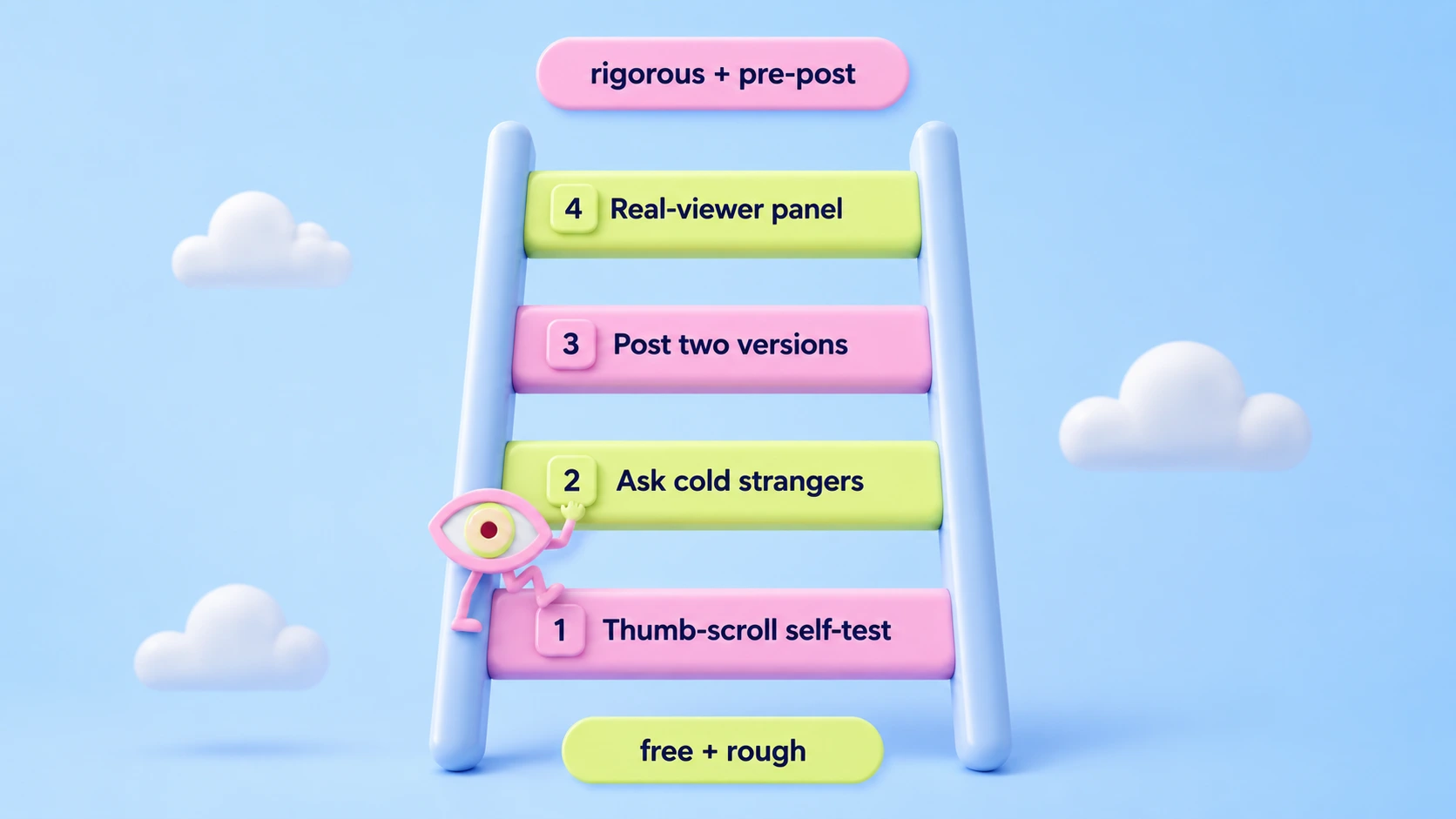
Four ways to test a hook before you post
1. The thumb-scroll self-test (free, rough)
Watch your own first three seconds on your phone with your thumb in scrolling position, and try to name the exact frame at which you would decide to keep watching. If you cannot point at a frame, the hook is not landing. It is the fastest check you can run, but it is the weakest, because you still know the payoff. It catches only the obvious misses.
2. Show the first three seconds to cold strangers
Send just the opener, not the whole video, to a few people who do not follow you and do not care about your topic. Ask one question: would you keep watching, and what made you decide. Better than testing on yourself, because they do not know the payoff. The limit: the sample is tiny, people are polite, and they are telling you what they think they would do, not what their eyes actually did.
3. Post two versions and read the retention graph
The live A/B. Post version A, post version B a few days later, and compare the first-three-seconds drop on each video's audience-retention graph. It uses real behaviour, but it is slow, it costs you reach on the losing version, and the result is confounded by posting time, the algorithm, and that day's feed. You also only learn after the post is already public.
4. Run it through real viewers before you post
A panel of real people watches your video on their phones with the front camera on, and you read where their gaze actually landed in the first three seconds and whether anyone reacted, before anything goes live. It is the only rung that measures real attention pre-post, on strangers, without spending a post to find out. This is what Jeena does.
You already passed your own hook test the moment you made the video. The only test that counts is one you are not allowed to take.
What a hook test actually measures
Watching a video is not the same as testing it. A test answers specific questions about the first three seconds, and for a hook there are only three that matter.
- Did the gaze land where you wanted?The attention heatmap for the opening frames shows whether viewers' eyes hit the thing you built the hook around, your face, the text, the product, or whether they went looking somewhere else entirely.
- Did attention lock or scatter?A tight cluster in the first second means the opener gave the eye one clear place to settle. A heatmap that is already spread across the frame by second two means nothing held them, and they are halfway to a swipe.
- Did anyone react at your intended beat?The wow-moments come from eyebrow raises caught on the front camera. If your opener is meant to land a surprise or open a question, the wow-moments tell you whether it actually registered or just slid past.
The cheapest test you can run in the next ten minutes
Combine rungs one and two. Watch your own first three seconds in scrolling position and name the frame you would commit at. Then send just those three seconds, not the whole video, to three people who do not follow you and do not care about your topic. Ask them one thing: would you keep watching, yes or no, and why.
It is rough and the sample is tiny, but it costs nothing and it breaks the spell of your own knowledge. If two of three say they would swipe, you have learned something the export never told you, and you have learned it before spending a post to find out.
What a passing hook test looks like
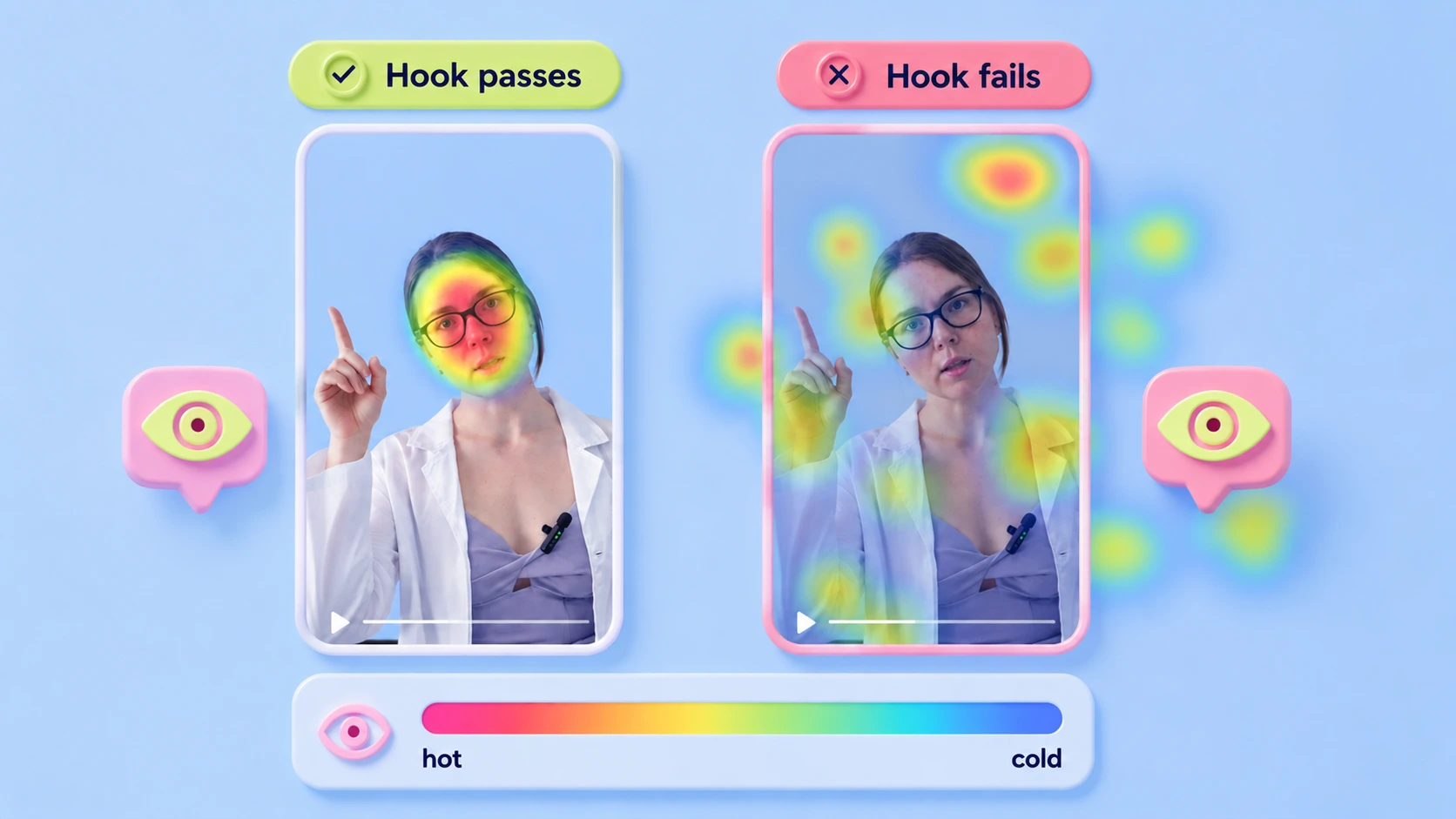
On a real-viewer test, a hook that works shows up as three things at once. In the first three seconds the panel's gaze converges on the one thing you wanted seen, the heatmap stays tight rather than diffuse, and at least a couple of viewers register a wow-moment at your opening beat.
A failing one is just as legible. Gaze checks your face for a moment, then drifts to the background or the caption corner. The attention map is already scattered by second two. No one reacts. The good news is that you are reading this before the post is live, which means it is still cheap to fix.
What to do when the hook fails the test
Do not rewrite the whole video. A failed hook test almost never means the video is wrong; it means the opener is. Reshoot only the first three seconds. Film three versions with three different entries, the way I describe in what is a hook, and test the openers again.
The hook is the cheapest part of the video to redo and the most expensive part to get wrong. Three seconds of reshoot against a whole post's worth of lost reach is the best trade in short-form video. Testing first is how you make that trade on purpose instead of by accident.
If you are wondering how many viewers it takes to trust the result, five viewers catch most of it. And if you want to read the attention map itself, here is how the heatmap works.
Test your hook on real viewers before you post
Upload your video to Jeena. Real viewers watch it on their phones with the front camera on, and the report shows you where their eyes landed in the first three seconds, whether attention locked or scattered, and whether anyone reacted to your opener. If the hook is leaking, you see exactly where, before the post goes live.
No "schedule a call." No sales rep. Upload, get your report in a couple of days, and fix the opener while it is still cheap to fix.
Frequently asked
How do you test a hook before posting?+
Put just the first three seconds in front of people who are not you. The rough version is to watch it yourself in scrolling position and then send the opener to a few strangers and ask if they would keep watching. The rigorous version is to run the video through a panel of real viewers with front-camera eye-tracking, which shows where their gaze actually landed in the opening seconds and whether anyone reacted, before the post goes live.
How many people do you need to test a hook?+
Fewer than you think. The recurring problems in an opener show up fast, so a panel of five to ten viewers catches most of what is wrong with a hook. Five is enough to surface the obvious misses; ten catches the long-tail ones. Testing fifty would mostly confirm what the first handful already told you.
Can you test just the first three seconds of a video?+
Yes, and for a hook you should. The decision to stay or swipe is made by the third second, so the opening frames are the only part of the timeline the hook test reads. You upload the whole video, but for the hook specifically only the first three seconds of the attention timeline matter: whether gaze converged, whether it held, and whether anyone reacted.
What is Jeena?+
Jeena is a neuromarketing platform for short-form video. Real people watch your video on their phone with the front camera on. Jeena captures their gaze direction, blink rate, eyebrow raises, and their impressions of the video in a short survey afterward. You receive an AI-powered report with an attention heatmap, a visibility map, a wow-moments chart, a summary of how viewers perceived the video, and three specific recommendations for making the video work harder.
How does Jeena measure viewer attention?+
Jeena uses smartphone front-camera gaze tracking. Each engager calibrates once, then watches your video. The platform records where their gaze lands frame by frame, flags moments of surprise from facial expression, and combines that with a short impressions survey afterward. The result is a per-second timeline of what real viewers actually looked at and felt, plus a summary of how they perceived the video overall.
How much does it cost to test a video on Jeena?+
A typical test costs around ten euros. See the pricing page for current rates.