Everything eye tracking caught that analytics missed
Nine findings from our published tests that no dashboard could have surfaced, collected in one place. The pattern across them is the real lesson.
Why I collected these
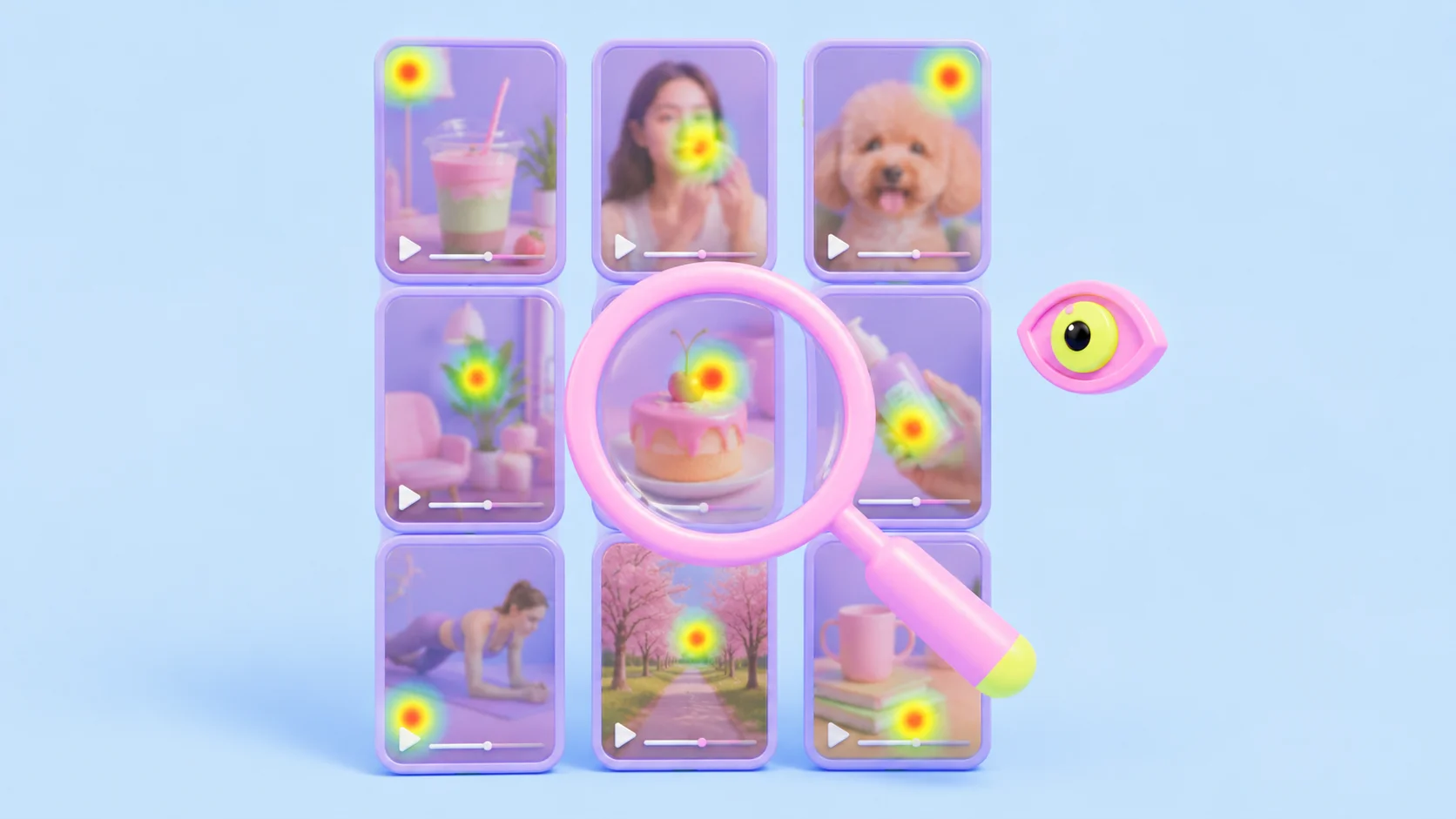
Every test we publish produces one finding that makes someone say "there is no way I would have guessed that." After enough tests, those findings started rhyming, and the rhyme is more useful than any single case. So this is the collection: nine things eye tracking caught in real short videos that views, likes, comments, and retention curves are structurally blind to.
Each finding links to its full write-up with the methodology and the numbers. All of them come from real tests: 5 to 10 real viewers per video, watching on their own phones with the front camera tracking gaze.
The nine findings
1. A dermatologist's lab coat got more attention than her face.
36% of gaze on the coat versus 24% on her face while she explained a skincare routine, rising to 52% versus 19% by the last section. The most credible object in the frame out-competed the person wearing it. From the skincare comparison.
2. An acne closeup out-pulled the product it was selling, 64% to 30%.
Viewers stared at the problem texture, not the bottle beside it. High-contrast texture is a gaze magnet even when it is the "before" and not the product. Same test as the lab coat.
3. A creator's own hook caption ate her face.
A remake placed its hook caption across the speaker's forehead, and viewers' gaze locked onto the caption instead of her; the original, with the caption above the head, anchored gaze on the face from frame one. From the remake comparison.
4. A mountain backdrop beat the tutorial in front of it.
In a faceless edit-app tutorial, gaze physically left the phone mockup and drifted into the scenic sky; the tutorial UI sat in a low-attention zone. The cleaner tutorial lost to the person-led version 117x on views. From the tutorial comparison.
5. Kitchen cabinets stole an outfit reveal.
In the lower-performing of two near-identical outfit-change reels, gaze slipped off the outfit to the kitchen cabinets behind the creator at exactly body height during the reveal. From the outfit-swap comparison.
6. The identical hook worked twice, and the videos still finished 7.6x apart.
Two tutorials opened with the same line word for word; both openers measurably landed (one produced a 50% wow spike at 1.3 seconds). The gap came from runtime and endings, not the hook everyone would have blamed. From the same-hook comparison.
7. A banana prop upstaged a call to action.
On the closing frame of a 1.8M-view tutorial, gaze landed on the creator's tank top and a banana on the desk instead of the "Save and Follow" line. Even winners leak; this one just leaked one second of fifteen. Same test as finding 6.
8. An ending played to an audience that had already left: 91% were not looking.
The longer of the two same-hook tutorials closed with a CTA card that roughly 18% of viewers ever glanced at, while about 91% were looking away entirely. Its report's fix was radical: publish an 8-10 second cut.
9. The luxury props behaved exactly like the broke followers they warned about.
Across three videos about attracting an audience that pays, the aspirational decor (a lifestyle collage, curtains and jewelry, a city skyline) leaked gaze during the money claims, while the concrete proof elements were each video's strongest hold: an example account at 40.9% of gaze, a product demo at 56.3%. From the three-way comparison.
The pattern under all nine
Not one of these is a content problem. The ideas were fine, the hooks mostly worked, the production was competent. All nine are auction problems: at some decisive moment, something in the frame outbid the thing the video needed seen, a coat outbid a face, a texture outbid a product, scenery outbid a tutorial, a prop outbid a CTA.
And the auction is invisible from every dashboard, because dashboards measure the aftermath. Views, likes, and retention record what the verdict was. The gaze data records how the jury reached it, and the jury's reasons turn out to be small, physical, and fixable: move a caption, quiet a background, cut two seconds, mirror an opener.
The viewer sees about two degrees of your frame at a time. These nine findings are what happens when those two degrees are spent at the wrong counter.
Dashboards record the verdict. Eye tracking records the deliberation, and the deliberation is where the fixes live.
And at scale, the pattern gets stranger
These nine findings are per-video catches. When we aggregated every video processed over four months (88 videos, ~530 viewer sessions), the auction pattern held, backgrounds collect 25.5% of on-screen gaze, more than faces, and a stranger pattern emerged on top of it: the videos viewers physically watched hardest were the ones they rated lowest. Staring, it turns out, marks effort rather than enjoyment.
That inversion, and the evidence that liking is driven by the ear more than the eye, is the subject of the Attention Paradox study, the aggregate companion to this list.
What to do with this list
Use it as a pre-flight checklist for your next video: what is the loudest texture in each scene, and is it the thing I need seen? Is any caption touching a face? What is behind me at body height? What is on screen in my final second, and would I bet ten euros that anyone is looking at it?
Or skip the guessing and run the test the list came from: how a test works and what it costs, and the step-by-step for your first one. Every finding above cost around ten euros to surface and one edit to fix.
Find your video's finding number ten
Upload your video to Jeena. Real viewers watch it on their phones with the front camera on, and the report shows an attention heatmap, a visibility map, a wow-moments chart, a summary of how viewers perceived it, and three concrete recommendations, typically within a day.
No "schedule a call." No sales rep. Upload, get your report.
Frequently asked
What can eye tracking find that video analytics cannot?+
Analytics measures outcomes after publishing: views, likes, watch time, drop-off points. Eye tracking measures the mechanism while watching: which region of the frame held gaze, what was never seen, and what was on screen at the moment attention left. In our published tests that mechanism layer surfaced findings analytics is blind to by design: a lab coat out-pulling a face, a caption blocking its own speaker, a backdrop defeating a tutorial, an ending playing to viewers who had already looked away.
Are these findings one-off flukes or a pattern?+
A pattern, and a consistent one: every finding is a case of something in the frame outbidding the intended subject for the viewer's limited sharp vision. The bidders change (props, textures, scenery, captions, backgrounds), the auction does not. That consistency is also why the fixes are cheap: they are placement and timing corrections, not reshoots.
What is Jeena?+
Jeena is a neuromarketing platform for short-form video. Real people watch your video on their phone with the front camera on. Jeena captures their gaze direction, blink rate, eyebrow raises, and their impressions of the video in a short survey afterward. You receive an AI-powered report with an attention heatmap, a visibility map, a wow-moments chart, a summary of how viewers perceived the video, and three specific recommendations for making the video work harder.
How does Jeena measure viewer attention?+
Jeena uses smartphone front-camera gaze tracking. Each engager calibrates once, then watches your video. The platform records where their gaze lands frame by frame, flags moments of surprise from facial expression, and combines that with a short impressions survey afterward. The result is a per-second timeline of what real viewers actually looked at and felt, plus a summary of how they perceived the video overall.
How much does it cost to test a video on Jeena?+
A typical test costs around ten euros. See the pricing page for current rates.